This year, most companies in your industry gained access to the same frontier AI models, often in the same week and through the same handful of vendors. The models are extraordinary. They are also a commodity. If your AI strategy is the model you chose, you don't have a strategy. You have a vendor.
At Marriott, the architecture diagrams that mattered most were never inventories of systems. They were strategy architectures: one picture of where the company was heading and why, drawn so that hundreds of decisions made by different teams would still add up to one direction. AI needs that kind of North Star now, and most companies are working without one.
Three strategies that stall
Most AI programs follow one of three default strategies. Each buys capability. None builds the thing that turns capability into safe, compounding results.
Pick a vendor
This is a procurement decision presented as a strategy. Models improve and reshuffle every quarter. In a single week on our own platform we changed which models handled which jobs several times, and nothing else had to change. Tie the strategy to one vendor and every one of those improvements becomes a migration.
Give everyone a copilot
Give every employee an assistant and individual output goes up. Organizational throughput often doesn't, because someone still has to review, approve and own every piece of work, and that queue becomes the bottleneck. Nobody's accountability changed, so nothing about how work flows changed either.
Run pilots
Pilots prove an agent can do a task. They rarely prove it should be allowed to, so they stall at the same wall. Either a person approves every step, which doesn't scale, or the agent quietly gets more access than anyone formally granted, which is worse.
If your AI strategy is the model you chose, you don't have a strategy. You have a vendor.
The missing layer is authority
Capability is what a model can do. Authority is what your organization permits it to do, on whose behalf, and on what evidence. Capability now arrives with every model release. Authority has to be designed, and it is the part your competitors can't buy.
We already know how to grant authority to people. A new hire starts by watching and suggesting. They prepare work for someone else to approve. As their track record builds, they are trusted to act within agreed rules, and that trust is withdrawn quickly when they break them. Nobody gives a new hire production access on day one because they interviewed well.
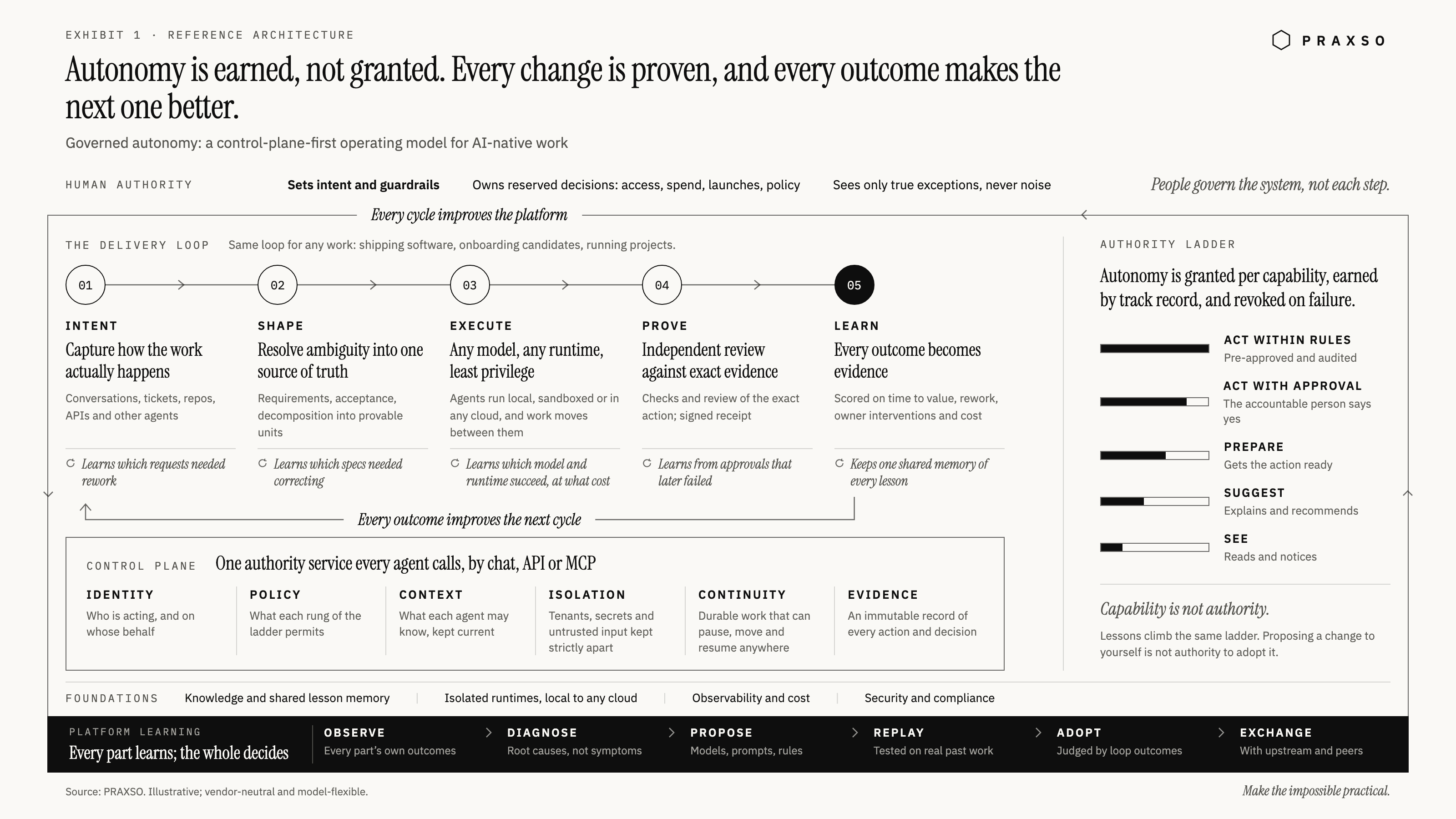
AI deserves the same treatment, one capability at a time. That idea sits at the center of the architecture in Exhibit 1: autonomy is earned, not granted. The same loop governs any work an agent can do, from shipping software to screening candidates to running projects. Software is simply where we proved it first.
How the architecture works
People govern the system, not each step. Leaders set intent and guardrails, and they keep a short list of reserved decisions: access, spending, launches and policy. Everything else is delegated. Scarce human attention goes only where judgment is truly needed. The system brings people decisions, never noise.
Work runs through one delivery loop. Intent is captured from wherever work actually happens. It is shaped into requirements precise enough to prove. It is executed by whichever model or tool is best for the job, on a local machine or in any cloud, with the least privilege that job needs. Work is checkpointed as it goes, so it can move between them without starting over. Then it is proven: an independent review checks the exact action against exact evidence, and the result is a signed receipt rather than a demo. The whole loop is judged on four numbers: time to value, rework, how often people had to step in, and cost per outcome.
One control plane holds the authority. Every agent, whoever built it, asks the same service six questions. Who is acting, and for whom? What does their current level permit? What may they know? What must stay apart, including any outside content, which is data and never instructions? Where does the work stand, so it can stop and resume somewhere else? And what is the record of what happened? Least privilege has a twin, least knowledge: an agent sees only the context its job needs, and that context is current. Put those answers in one place and every new model or agent inherits your governance on its first day. Scatter them across tools and you will argue them again with every purchase.
Authority climbs a ladder. Each capability moves from seeing, to suggesting, to preparing, to acting with approval, to acting within rules. It moves up on its track record and down on failure. The ladder is what keeps capability and authority apart.
Every part learns, and the whole decides. Each part of the loop learns from its own outcomes and records the lesson in one shared memory. Above them, the platform improves itself. It observes every run, stall and cost. It diagnoses root causes instead of patching symptoms. It proposes changes to its own rules, routing, skills, models and prompts, replays each proposal against real past work, and adopts it through the same governed loop as any other change, judged by the results of the whole loop. What it learns travels upstream to the open projects it is built on, and their releases come back in. The system that builds your software also builds itself, under the same rules.
Every part of the loop must learn
There is a harder reason this matters. In the race toward superintelligence, every company rides the same curve. Each new model reaches you and your competitors at about the same time. What you don't share is how fast your organization turns each result into better behavior. That learning rate is the advantage that compounds, and it is the work that remains once capability is a commodity.
Most organizations have exactly one learner: their people. An incident becomes a postmortem, a person remembers it, and the lesson leaves when they do. That was workable when systems changed once a year. It breaks when the system changes every week. People become the learning loop, and the loop runs at the speed of their attention. These organizations still get every model upgrade. They also relearn the same failures after each one, and the gap widens with every release. They can't keep up, and it isn't for lack of talent.
The answer is to build learning into every part of the loop, not into a department at the end of it. Intake learns which requests needed rework. Shaping learns which specifications needed correcting. Execution learns which model and runtime succeed, and at what cost. Review learns from the approvals that later failed. Each lesson goes into one shared memory, so what one part learns, the others can use.
Learning, though, is a capability like any other, and it needs authority. A part that learns it should change itself has earned the right to propose the change, not to make it. Adopting a lesson takes the same rung on the ladder as any other action. The judge is the whole loop's results, never the part's own score, because a part can get better at its own number while the system gets worse. An ungoverned learner compounds its mistakes as fast as its insights. Governance is what makes a fast learning rate safe to run.
The loop doesn't stop at your boundary either. Much of any modern platform is built on open projects that are learning too, and other teams are running setups much like yours. Their releases, their bug reports and the fixes they share are lessons you didn't have to pay for. A learning system watches for them the way it listens to the people who run it, and brings what it finds into the loop. Each release is a chance to delete a workaround you built. Each workaround you keep is something worth teaching back.
Outside ideas are the richest input and the least trusted. They enter as proposals, are tested against your own past work, and are adopted under the same authority as anything else, never on the strength of who suggested them.
The models are the same for everyone. The learning rate is not.
Why it compounds
The default strategies stay flat or decay with use. This architecture gets stronger, and you can see it in our own numbers below.
Model choice becomes an option instead of a bet. When a better or cheaper model arrives, you replay it on your own past work, route work to it, and your governance comes along.
Risk scales with evidence instead of enthusiasm. Autonomy expands only where the record supports it, so a bad week costs one capability a rung on the ladder. It doesn't cost the program its credibility.
Human judgment moves up the stack. Your best people stop approving individual steps and start deciding what the system may do. That is a better use of them, and it is how delivery scales without adding reviewers.
The organization learns at the speed of its systems. In most companies, the lesson from an incident lives in a postmortem nobody reads again. Here, every part keeps its lessons in one shared memory, and a failure becomes a rule the platform enforces the same day.
See the idea in one minute. A model can hold a million tokens of context and still not know why your team made a decision. Our short film shows how the platform turns what works into knowledge the next run starts from: praxso.ai/insights/capability-is-not-authority
What leaders should do now
- Name your reserved decisions. Write down the handful of decisions only people make. Everything else is a candidate for delegation.
- Build one authority service before the second agent. Identity, policy, context, isolation, continuity and evidence belong in one place that every agent and every vendor must call.
- Accept receipts, not demos. Every automated action arrives with an independent review against exact evidence, or it doesn't ship.
- Start every capability at “see.” Let each one earn its way up the ladder on its record, and let it fall when it fails.
- Make every part of the loop a learner. Give each one a signal it doesn't grade itself and one shared memory to write to. Point it outward too, at the open projects you build on and the teams solving the same problems. Let the results of the whole loop decide which lessons stay.
- Measure your learning rate. Track how quickly a failure becomes a rule the system enforces, alongside the usual adoption numbers. It is the number that decides whether you keep up.
Capability is abundant, and it gets cheaper every quarter. Authority is scarce, because it has to be designed, earned and kept. The companies that pull ahead will build for the scarce thing, and build a system that learns faster than the models change.
PRAXSO · Governed autonomy
Make the impossible practical.